
EV Charger Installation in Haywards Heath: Why the Consumer Unit Matters as Much as the Charger
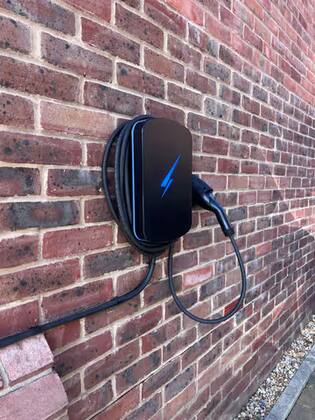
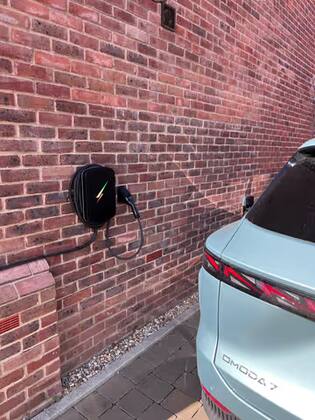
We recently completed an EV charger installation for a customer in Haywards Heath — a Hypervolt Home 3 Pro, fed from a brand new dedicated consumer unit fitted on the front of the property. It’s a good example of a job that looks simple from the outside (a box on the wall with a cable) but has a fair bit of thinking behind it before the charger ever goes up.
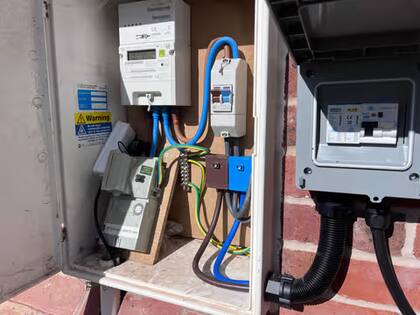
Why an EV charger needs its own consumer unit
A lot of people assume an EV charger can just be wired into whatever spare way is left in the existing consumer unit. Sometimes that’s possible, but increasingly we’re fitting a second, dedicated consumer unit specifically for the charger — as we did on this job.
There are a few reasons for that. BS 7671 (the UK wiring regulations) requires the circuit feeding an EV charge point to be dedicated to that purpose alone — it can’t share a circuit with sockets or lighting, and no “diversity” can be applied to reduce the cable or protective device sizing, because a car can draw its full rated current for hours at a time. On an older board with limited spare ways, or one that’s already fairly full, a separate consumer unit is often the cleanest and safest way to give the charger its own properly sized, properly protected circuit without disturbing everything else in the house.
Protecting against PEN faults
Most UK homes are supplied on a PME (TN-C-S) earthing system, where the earth and neutral share a conductor back at the substation. In the rare event that conductor fails, metalwork connected to earth at the property can become live — and because an EV charger is typically mounted outside, and the car itself is effectively a large piece of earthed metal someone is standing next to, the regulations (Section 722 of BS 7671) take this seriously. Installations have to include protection against this fault, either through the charger’s own built-in protection or an additional device, and — where that isn’t achievable — alternative earthing arrangements.
The Hypervolt Home 3 Pro we fitted on this job has PEN fault protection built into the unit itself, which is one of the reasons we like specifying it: it meant we didn’t need to install a separate earth rod at the property, keeping the installation tidier and the groundwork to a minimum.
RCD protection
Every EV charge point also needs its own RCD protection, rated no higher than 30 mA. Because the charging current can carry a DC component, a standard Type AC RCD isn’t good enough — the regulations call for at least Type A, stepping up to Type B where the DC component could exceed 6 mA. Most modern chargers, including the Hypervolt, have appropriate protection built in, but we still check and confirm this as part of the design for every installation rather than assuming.
Choosing the charger for this EV charger installation in Haywards Heath
For this job we fitted a Hypervolt Home 3 Pro — a 7.4kW, 32A tethered unit with a Type 2 cable. It’s smart-enabled, so it can be scheduled to charge overnight on a cheaper tariff, monitored and controlled from a phone, and it plays nicely with time-of-use tariffs from suppliers like Octopus. It’s also on the government’s list of chargers eligible under the Office for Zero Emission Vehicles (OZEV) scheme, which matters for grant eligibility (more on that below).
Is there still a grant available?
It depends on the property. The original EV chargepoint grant for homeowners with off-street parking closed some time ago, so most people fitting a charger at a house with a driveway — like this job — are covering the full cost themselves. However, grant schemes of up to £500 are still running for renters and flat owners with their own parking, and separately for households who only have on-street parking and need a cross-pavement charging solution. Both are worth checking if either applies to you, as they’re currently set to run until March 2027.
What to expect from a professional EV charger installation in Haywards Heath
A proper EV charger installation isn’t just mounting a box on the wall. We assess the existing supply to make sure it can comfortably take the extra load alongside everything else in the house, decide whether a dedicated consumer unit is the right approach (as it was here), route and protect the cable correctly, and test and certify the finished installation before handing it over. If you’re considering an EV charger, our EV charger installation page has more detail on what’s involved.
If you’d like a quote for an EV charger installation in Burgess Hill, Haywards Heath or anywhere else in Mid Sussex, give us a call on 01444 682683 or get in touch and we’ll be happy to help.